(This English version is intended only as a translation. Only the original version in Japanese is valid.) last updated:25 March 2024
 大東流合気柔術・居合術 | 神刀柔進会 | 合気柔術静岡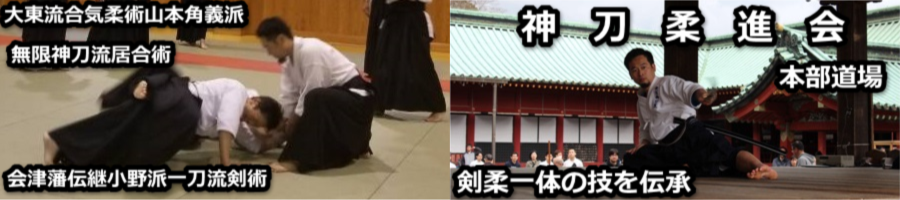
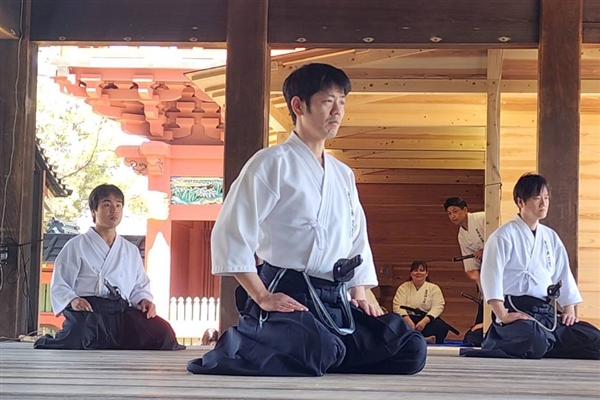
About Aizu Domain-style Ono-ha Ittō-ryū Kenjutsu(会津藩伝継小野派一刀流剣術について)
Takeda Sōkaku Minamoto Masayoshi(武田惣角源正義) was taught Ono-ha Ittō-ryū Kenjutsu(小野派一刀流剣術) in 1869 by Shibuya Tōma(渋谷東馬), kenjutsu (sword) instructor of the Aizu domain. In 1872-73, he was taught Jikishinkage-ryū Kenjutsu(直心影流剣術) by Sakakibara Kenkichi(榊原鍵吉) at the Kurumasaka Dōjō in Tokyo. In addition, he inherited Aizu-domain Shintō Seiburyū Kenjutsu(神道精武流剣術) and battōjutsu(draw-and-cut sword technique, 抜刀術) during his youth.
According to Yamamoto Kakuyoshi, Takeda Sōkaku had several live-blade fights during the Meiji and Taishō eras. He told Yamamoto that kenjutsu is a silent sword art in that one must not make any vocalization like in modern kendō. This was because revealing your breathing or timing would allow the opponent to read or anticipate your movements. He also said that one must strike by chasing the opponent’s shadow. At Sakakibara's dōjō, no voices were ever raised; and for kenjutsu training beans (soybeans or adzuki beans) were scattered across the floor. One must be able to use the sword regardless of the environment. This is believed to be the Way of the Sword.
Takeda Sōkaku asked Yamamoto to suspend a silk thread from the ceiling and could cut it with a sword. He also asked Yamamoto to place two candles on a stand, and he extinguished the flames by horizontally cutting through them.
He told Yamamoto, “In a match, never let your opponent take the first point. Let them have the remaining nine. It will allow them to save face.” This teaching implied that in a real fight, the first strike would mean life or death. He also warned Yamamoto to never use a blade without a hand guard (shirasaya, 白鞘) in a real match. Without a guard, if the thumb were cut, his life would be over. Yamamoto Kakuyoshi also believed that there is no place for compassion when using the sword.
As the last live-in disciple, Yamamoto Kakuyoshi became an assistant instructor (教授代理)in 1941. In 1942, he received the Ōmenjō(大免状), the secret transmission of the inner mysteries of Daitō-ryū Aiki-jūjutsu(大東流合気柔術秘伝奥義之事), which meant that he received all secret martial arts teachings, including Ono-ha Ittō-ryū Kenjutsu, real sword techniques, and the secret methods of Aiki, directly from Takeda Sōkaku.
By integrating the principles of Daitō-ryū, he brought the system to completion as what is now known as Mugen Shintō-ryū Iaijutsu(無限神刀流居合術). This is how the swordsmanship philosophy of Takeda Sōkaku is carried on to this day.
Yamamoto Kakuyoshi said that Takeda Sōkaku was an extremely cautious person. He would not drink any tea unless it was brewed by Yamamoto himself. If someone else brewed it, he would wait until they drank from it before he would.
At bedtime, he would always place a tantō(短刀) under his pillow, a tessen(鉄扇, iron fan) by his bedside, and hide a tachi(大刀) beside his futon. This sword (recorded as Yukihira, 行平) was later passed to Yamamoto Kakuyoshi, along with a large purple haori cord(大羽織紐) made of silk, which had been granted to the Takeda family by Lord Matsudaira Katamori(松平容保公), lord of the Aizu domain.
Sōkaku also intended to teach shurikenjutsu(手裏剣術), but someone remarked that such techniques might be outdated in the modern era. Upon hearing that, Sōkaku shouted, “Foolishness!”
Nagao Zenyū later regretted not having learned it, and so do we now.
The founder of Ono-ha Ittō-ryū Kenjutsu, Ono Jirōemon Tadaaki (小野次郎右衛門忠明), was born in Isumi District, Kazusa Province and, in his youth, went by the name Mikogami Tenzen (神上典膳). He studied under the founder of Ittō-ryū, Itō Ittōsai Kagehisa (伊藤一刀斎影久), travelling with him across the country. He was granted full transmission of the school's secrets after engaging in a match using real swords against his senior disciple Ono Zenki (小野善鬼), as ordered by Itō Ittōsai Kagehisa. He later served Tokugawa Ieyasu and received a stipend of 500 koku (enough rice to feed approximately 500 people for one year).
His swordsmanship was considered superior even to that of Yagyū Munenori (柳生宗矩), so the third shogun, Tokugawa Iemitsu, never permitted them to face each other. Ono believed that if two swordsmen were equal in skill, the one with the longer sword, by even one or two sun (app. 3.03 cm), would have the advantage. His personal sword was called Namihira Yukiyasu (波平行安), 2 shaku 8 sun (app. 85 cm) in length.
Some documents describing both iai and kenjutsu, remain from the Edo period.
Iai must be practiced morning and night to truly understand it. Without repeated draws, the sword will not become part of you.
Beneath the crossing swords lies hell. Step in boldly, and you find paradise.
Aizu Domain-style Ono-ha Ittō-ryū Kenjutsu(会津藩伝継小野派一刀流剣術) Lineage:
•Itō Ittōsai Kagehisa(伊東一刀斉景久)
•Ono Jirōemon Tadaaki(小野次郎衛門忠明)
•Lord Hoshina Masayuki(保科正之) transmitted the techniques to Aizu (see Note)
•Ōtake Gakubee (大竹学兵衛), 13th-generation headmaster of Ittō-ryū Ono-ha
•Shibuya Tōma Sadayasu (渋谷東馬貞保), Aizu Domain fencing instructor in the late Edo period, with assistant instructor Takeda Zenjirō(師範代武田善十郎)
•Takeda Sōkaku Minamoto Masayoshi(武田惣角源正義)from 1869
•Yamamoto Ittōsai Kakuyoshi(山本一刀斉角義)
•Nagao Zenyū Ittōsai Kakuzan(長尾全祐一刀斉角全)
•Hiraoka Ittōsai Yasuhide(平岡一刀斉祥淑)
Note: Even within Ono-ha Ittō-ryū Kenjutsu, the teachings by Sasamori (笹森) belong to the Tsugaru tradition and differ in style and training methods from the Aizu Domain-style lineage passed through Daitō-ryū.